

Home Energy Model (HEM)
The Home Energy Model (HEM) is the UK Government’s new calculation methodology for assessing the energy performance of homes. It will supersede SAP 10.3 as the approved methodology for both Future Homes Standard (Part L 2026) compliance for new dwellings, and generating EPCs. Prepare your new-build residential projects for the Future Homes Standard.
What we do
Etude helped with development of HEM over the last 6 years. We led the SAP 11 scoping study in 2020-21, which highlighted 25 key recommendations to improve SAP and led to the HEM project.
We have provided quality assurance and validation services across the development of HEM, and the FHS and EPC wrappers, since 2022.
Help with HEM
We carry out HEM calculations and Future Homes Standard modelling for new-build residential projects, and can advise on SAP 10.3 compliance during the transition.
We developed in house tools to make the most of the new engine methodology and to improve analysis and outputs.
Etude are experienced building energy modellers, and can provide detailed advice on the new modelling requirements.
Why HEM matters
HEM can give you outputs relating to building performance which SAP is unable to produce. For example, detailed breakdowns of heat pump performance, or the interaction of solar generation with half-hourly dwelling demand and storage capacity.
Leaving compliance until the last minute risks late changes, delays and higher cost. Early modelling identifies issues before key decisions are locked in.
We recommend design teams start preparing now rather than waiting for it to become mandatory.
Latest home energy model articles


What is the Home Energy Model?
Half-hourly, not monthly
HEM simulates the environmental conditions and resulting energy consumption of a building for every half-hour of the year. SAP uses monthly averages.
Better for low-carbon systems
A much better picture of how building systems like heat pumps, solar PV, batteries and smart controls perform and interact.
Open source
HEM’s codebase is open-source. Anyone can download and interact with the python source code, although compliance modelling needs to use a locked version of the model hosted by the government (ECaaS)
More detailed inputs
Building geometry, fabric performance and product specifications all need to be described in more detail than in SAP. Modellers need more project information, and to be familiar with a wider set of conventions, to produce quality models.
The Home Energy Model is similar to SAP, but not the same
HEM:FHS and SAP 10.3 should give broadly similar results from a compliance perspective. Due to the significant differences in the underlying methodologies, they will not be the same.
What is a HEM wrapper?
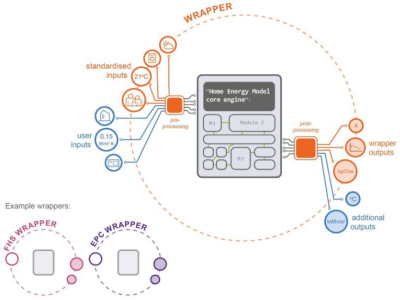
HEM is the core building physics model. Wrappers standardise inputs and outputs for different regulatory purposes: HEM:FHS for Future Homes Standard compliance, and HEM:EPC for EPCs.
SAP 10.3 only
SAP 10.3 is the approved methodology for Future Homes Standard compliance and for EPCs. Projects can already apply voluntarily under the Future Homes Standard.
HEM:FHS approved
HEM:FHS is expected to become an approved methodology. Either SAP 10.3 or HEM:FHS can then be used for compliance.
HEM:FHS only
After a transition period, SAP 10.3 is expected to be withdrawn for compliance, leaving HEM:FHS as the only approved methodology.
Who needs the Home Energy Model?
If compliance with Part L of the Building Regulations for new dwellings is relevant to you, then HEM:FHS calculations are for you.
HEM for housebuilders, developers and designers
Housebuilders and developers, architects and design teams will all need to understand the requirements and impact of HEM:FHS, and procure compliance modelling.
HEM for SAP assessors and energy consultants
SAP assessors and energy consultants will need to understand the requirements and impact of HEM:FHS, and deliver compliance modelling.
HEM for building control, local authorities and software developers
Building control bodies and local authorities need to understand the transition too. Software developers may be interested in leveraging the open-source HEM code or ECaaS API.
What this means for your project
Because HEM uses more detailed inputs, project teams will need better evidence for fabric, heating, hot water, ventilation, solar PV and battery specifications.
Stakeholders should also understand how their designs and specifications perform in HEM:FHS compared to SAP 10.3.
What we’ll need from your project team
- Site details and shading.
- Fabric, U-values and airtightness assumptions.
- Window and door data.
- Heating and hot water system details.
- Solar PV and battery specifications.
- Product-specific performance evidence.
Collecting this early avoids default values being used where evidence is missing.
How the Home Energy Model relates to Part L
Part L sets energy efficiency requirements for buildings. The Future Homes Standard raises the bar for new homes, and HEM is the methodology being developed to test new dwellings against it, while SAP 10.3 covers the transition.
How to prepare?
- Keep using SAP 10.3 as a simple tool to check compliance.
- Start collecting richer project data to support HEM:FHS calculations now.
- Review the performance of your designs and specifications in HEM:FHS early, so you understand how they compare to SAP and are prepared for the transition.
Etude are experts in the new requirements of HEM modelling. We can guide project data collection, carry out HEM calculations, model your project against the Future Homes Standard, and help you understand whether your homes meet the new Building Regulations.
Get in touch
Send an email to london@etude.co.uk with:
- Your name, contact details and role on the project.
- The client name and contact details.
- The stage the project is at and the headline programme.
- A brief description of the project.
Home Energy Model FAQs
1) What is the Home Energy Model?
The Home Energy Model (HEM) is the UK Government’s new methodology for assessing the energy performance of homes. It replaces SAP and will support Building Regulations compliance, including the Future Homes Standard for new dwellings.
2) What are HEM calculations?
HEM calculations model a home’s expected energy performance — heating, hot water, ventilation, ancillary loads and any on-site generation — using half-hourly simulation, to test compliance against Building Regulations.
3) Is HEM replacing SAP?
Over time, yes. HEM will replace SAP 10.3 as the approved methodology for both Future Homes Standard compliance and Energy Performance Certification. SAP 10.3 is the approved methodology for Future Homes Standard compliance at launch, and HEM is expected to become an approved alternative in the near future, with both methodologies usable during a dual-running period. EPCs are expected to transition to HEM later in 2027, and details will be released in due course.
4) Is SAP still valid?
Yes. SAP 10.3 is currently the approved calculation methodology for Future Homes Standard compliance and remains valid throughout the transition and subsequent dual-running period.
5) What is SAP 10.3?
SAP 10.3 is the current version of the Standard Assessment Procedure, updated to support Future Homes Standard compliance while HEM is finalised and approved.
6) When will HEM come into force?
HEM is expected to become an approved methodology for compliance with the Future Homes Standard “in the coming months”, as of June 2026. It will then run alongside SAP 10.3 for a minimum 24-month dual-running period.
7) What is the difference between SAP and HEM?
The most significant difference is time resolution — SAP calculates on a monthly basis, while HEM simulates every half hour, giving a more detailed picture of how heat pumps, solar PV, batteries and smart controls actually perform. HEM’s codebase is also open-source, and it needs more detailed project data than SAP.
8) Will HEM affect EPCs?
HEM is expected to supersede SAP as the approved methodology for generating EPCs later in 2027. It is not clear whether this will change the EPC rating for buildings, there are likely to be some borderline cases where this happens.
9) What information will I need for HEM calculations?
Detailed information from across the project team — architectural drawings, fabric specifications, heating and hot water system details, product data sheets, solar PV information, ventilation design and performance evidence. Etude are experienced HEM modellers, and can provide detailed advice on the new modelling requirements.
10) Should developers prepare for HEM now?
Yes. Even though SAP 10.3 remains valid, HEM’s data requirements are more detailed, so collecting richer project evidence now avoids delays later. Understanding how your designs and specifications perform in HEM is also important: fundamental differences between HEM and SAP 10.3 mean they will not be identical, and HEM will ultimately become the only approved methodology.
11) Do I need HEM calculations for an extension or conversion?
Probably not. HEM’s current focus is new dwellings and Future Homes Standard compliance. Extensions and conversions are typically assessed under existing Part L routes — get in touch if you’re not sure which applies to your project.
12) Can you help with Future Homes Standard modelling?
Yes. We carry out HEM calculations and Future Homes Standard modelling for new-build residential.